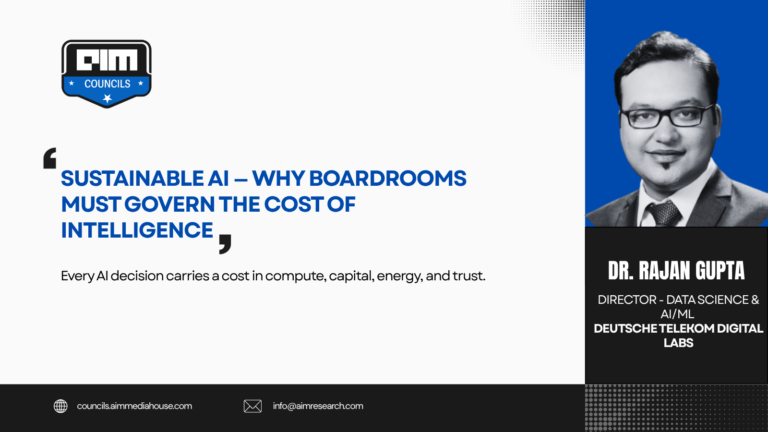
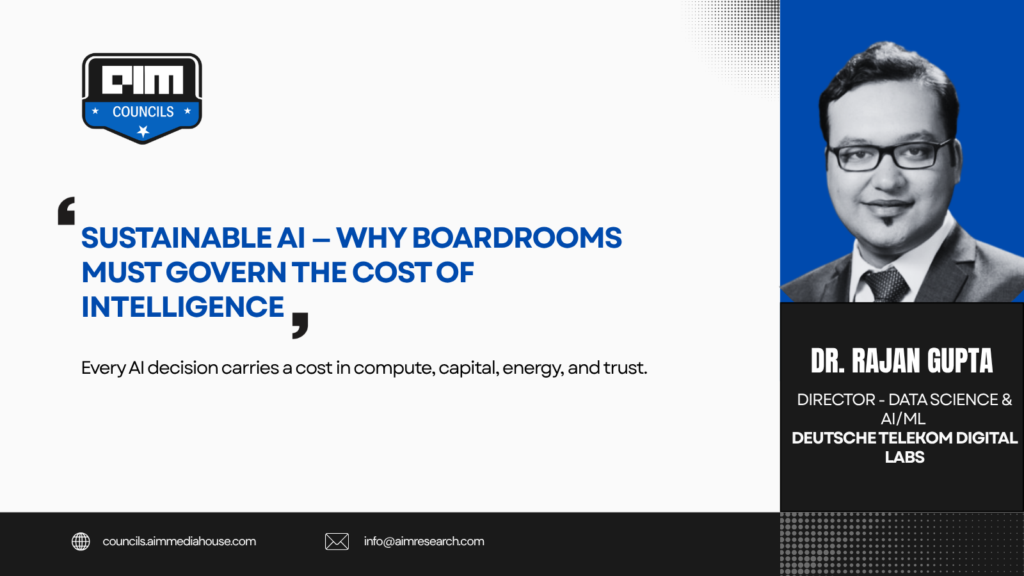
As enterprises race to deploy AI across the business, a recent IEEE publication on sustainable AI raises a timely question- what is the actual cost of intelligence at scale? Few leadership teams are asking it with enough urgency.
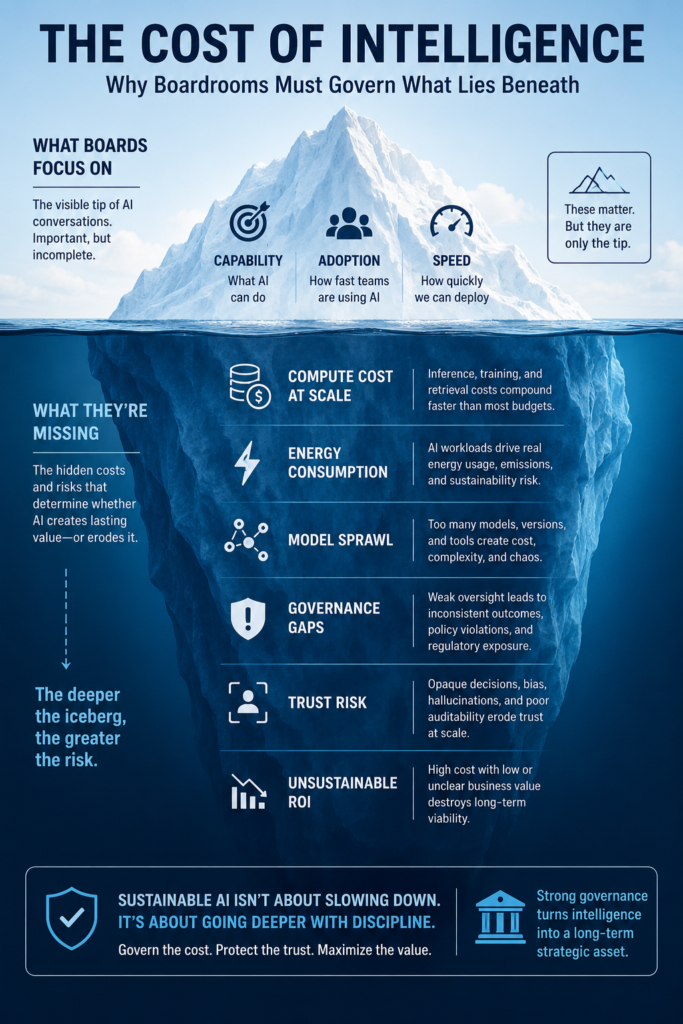
AI is no longer an experiment. It is becoming a permanent operating layer across customer service, knowledge work, software delivery, operations, and decision support. But most executive conversations are still stuck on capability, adoption, and speed. They miss the harder issue, whether the organization can afford to scale AI responsibly across cost, compute, energy, governance, and trust.
Sustainable AI is the discipline of turning intelligence into a long-term strategic asset. The enterprises that master it will build systems that are not only powerful, but efficient, accountable, and resilient.
AI Excitement to AI Economics
Most organizations still measure AI by the wrong things, model sophistication, pilot speed, and user enthusiasm. None of that is sufficient.
Scaling AI is easy to celebrate and difficult to govern. A promising pilot quickly becomes dozens of deployments across functions and geographies. The challenge is not adoption, it is ensuring that the business case remains intact as AI becomes embedded in the enterprise.
As AI spending grows, boards must move beyond enthusiasm and demand greater accountability. Are we deploying advanced models only where they create meaningful advantage? Are we solving material business problems or scaling costly inefficiencies? Are we measuring return on intelligence, or merely counting use cases?
Sustainable AI starts when leaders stop treating computers as an invisible utility and start treating it as a governed capital. The challenge is not whether to scale AI. It absolutely should be scaled. The challenge is whether it is being scaled with discipline. In the next phase of enterprise AI, strong governance will create more advantage than clever prompting.
Built for Sustainability
There is a common misconception that sustainable AI means slowing down ambition. It does not. It means building and governing AI with enough maturity that growth does not create hidden fragility.
In practical terms, this changes how enterprises design their AI stack. Not every task needs a frontier model. Not every workflow needs real-time inference. Not every use case should be kept running simply because it once looked innovative. Mature organizations will build AI portfolios the way good investors build capital portfolios, selective, monitored, and continuously rebalanced.
This is also where sustainable AI becomes a trust issue. Poorly designed AI systems do not just consume more resources. They create weaker accountability, fragmented governance, inconsistent outcomes, and avoidable risk.
The strongest enterprises will combine three disciplines: model right-sizing, lifecycle governance, and measurable oversight. That means knowing what to automate, what to augment, what to retire, and what to escalate for human review. Sustainable AI is not a moral add-on to the AI agenda. It is the operating model that separates serious enterprises from those still confusing pilots with readiness.
Sustainable AI in Practice
Fit-for-Purpose Models
In enterprise assistant deployments, one of the most effective early decisions was designing for model tiering from the start. Lightweight models handled search, retrieval, policy guidance, and repetitive summarization. Larger models were reserved for reasoning-heavy tasks. This reduced compute intensity and improved commercial viability at scale.
Sustainable AI begins with a simple discipline: align compute intensity with business value.
Rethink the Workflow
In several transformation programs, the improvement did not come from the model. It came from redesigning the workflow around the model. Instead of fragmented AI calls across review chains, we built governed pipelines for extraction, summarization, validation, and exception handling. That improved turnaround time, reduced rework, and cut unnecessary inference load.
Sustainable AI often comes from operational redesign, not model obsession.
Risk-Aware AI
In customer-facing journeys, sustainable AI was achieved by routing low-risk, high-frequency interactions through efficient models, while keeping human-in-the-loop controls for edge cases and sensitive decisions. This protected trust and avoided compute waste in routine transactions. It also improved auditability, something boards consistently underestimate until scale exposes the gap.
Portfolio Discipline
At the Center of Excellence level, one of the most useful changes was adding efficiency and reuse into portfolio reviews. Teams were no longer asked only what business value they created, but whether they reused components, controlled retraining frequency, governed model sprawl, and justified infrastructure cost. That is when AI moved from a wave of pilots to a managed enterprise capability.
Conclusion
Sustainable AI is where the conversation moves beyond possibility and into accountability. It reminds enterprises that intelligence has a cost, and unmanaged intelligence rarely remains strategic for long.
Enterprise AI success depends on disciplined execution, responsible governance, and the consistent creation of business value at scale.
Boards should push management beyond adoption metrics. Build sharper discipline around AI economics, model governance, portfolio rationalization, and long-term operational trust. Sustainable AI is about making better decisions about where intelligence belongs. Companies that do this well will create operating advantages that compound over time and become increasingly difficult to replicate.