
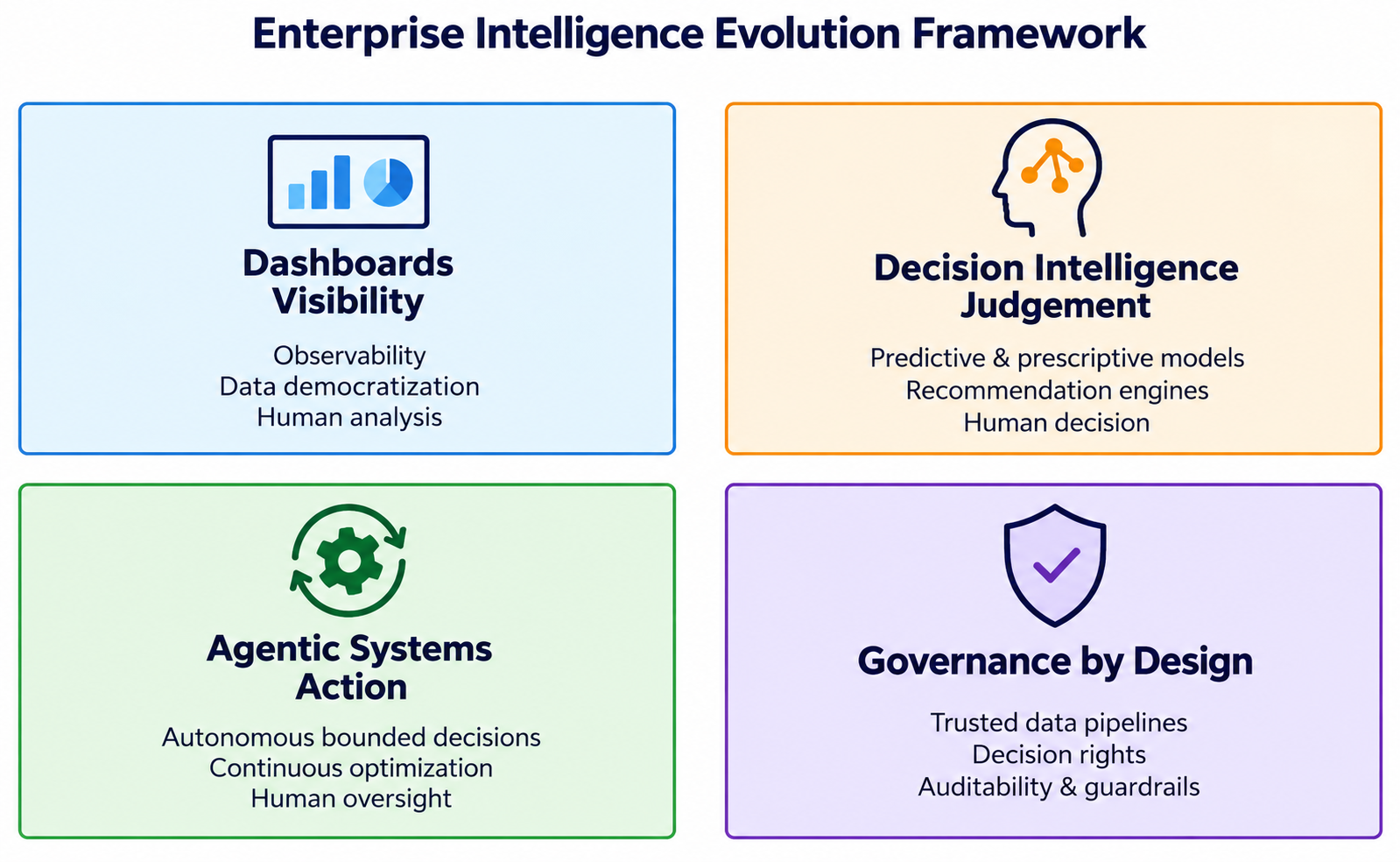
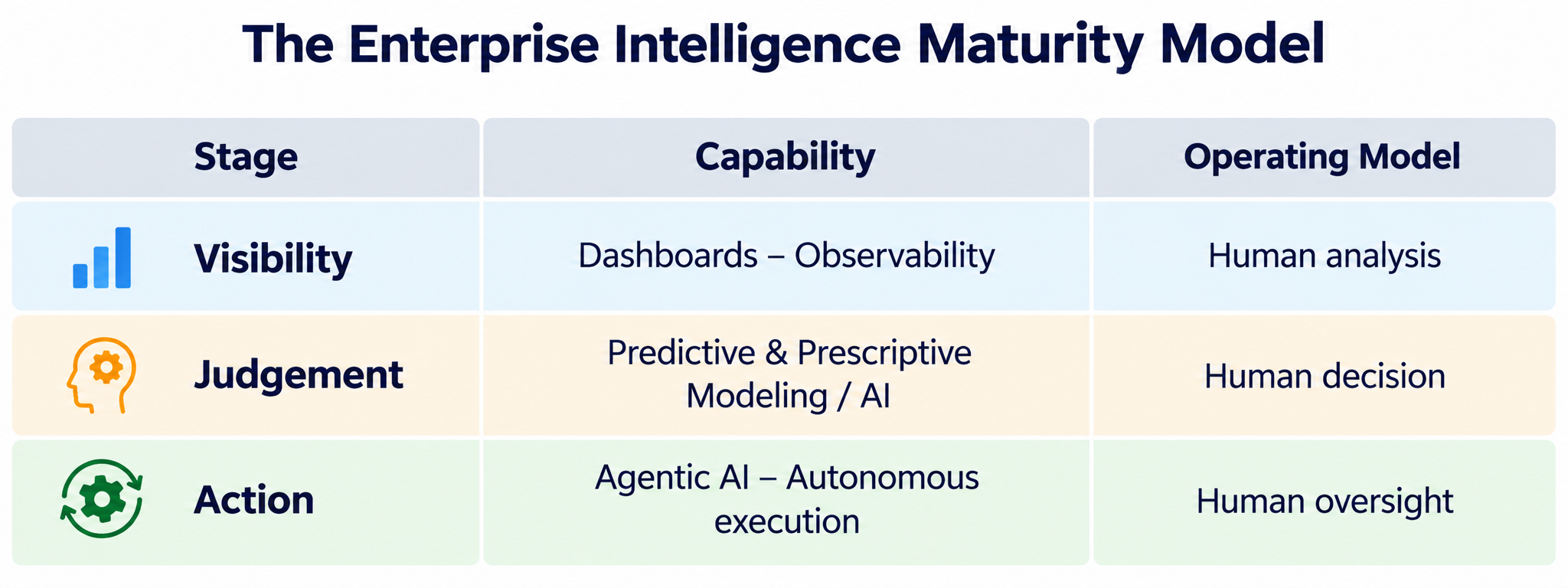
The evolution of enterprise analytics is moving through three distinct phases:
1. Dashboards enhancing visibility
2. Decisions with technology augmenting human-judgment
3. Actions through agentic execution by technology on behalf of humans
Each stage involves a trade-off between value creation and governance risk.
As organizations move from dashboards to agentic systems, the marginal value of human-driven analytics declines, while the governance risks of autonomous decision-making increase.
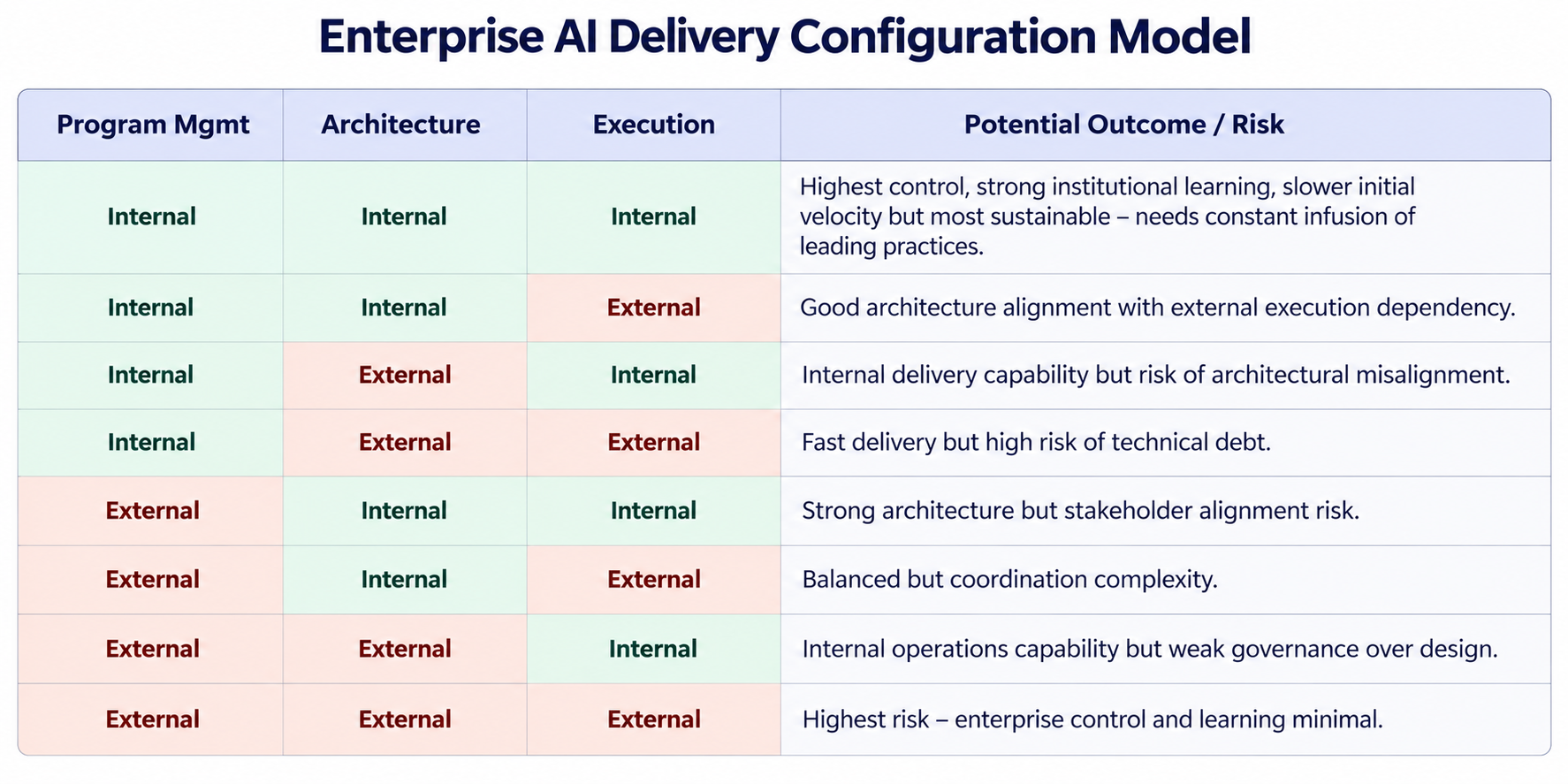
The focus shifts from how systems are engineered to how quickly solutions can be assembled and deployed, and trade-offs arise between architecture effort and program management - complementary capabilities for successful deployment. This tension and trade-offs must be managed.
1. The Dashboard Plateau
Many enterprises invested heavily in BI – in the early 2000s through 2020s, there was a self-service analytics boom driven by BI – particularly with Tableau, Qlik, Tibco Spotfire, SAP Lumira amongst other leaders. The thinking here was to equip people in the business with every dimension of information thought necessary to increase visibility of business – consequently improving decision quality. To support these tools and the self-service analytics paradigm, data lakes and functional data marts were invested in.
After a point, the dashboards were thought to influence diminishing marginal value, as evidenced by a large industrial giving a mandate to standardize and rationalize it’s 3000+ dashboards / reports to 150 or less.
Perceived reduction in value of BI could be attributed to:-
overlap of information and many alternate and sometimes conflicting views shown by self-service BI storyboards
decision latency remains high
insights depend on human interpretation
action cycles remain slow
Over the past decade, enterprises invested billions in dashboards and self-service analytics. Yet many leaders acknowledge a plateau: dashboards show us what happened, but they rarely change what happens next.
The dashboards delivered:
observability
data democratization
performance transparency
But limitations included:
cognitive overload (multiple KPIs across multiple dimensions and filters – required deep analysis of the data)
interpretation dependency
decision bottlenecks
Dashboards improved awareness but did not fundamentally change the operating cadence of organizations. Asks for simply showing the top (n) actions needed to be taken to improve the situation started coming in.
2 – Decision Intelligence
This stage is where many companies are today – where automation powered by statistical learning / machine learning helps narrow the scope and uncertainty around decision choices. This is largely characterized by:-
predictive models
recommendation engines
prescriptive analytics.
While this is a cognitive leap from BI driven decisions in terms of
Scientifically justifiable decision quality
scenario evaluation
augmented managers
Even so, humans continue to interpret outputs with episodic decisions and operating cadence still depends on meetings.
3 – Agentic Action Systems
In this context, we refer to Agentic systems which are AI systems capable of executing bounded decisions autonomously within defined governance guardrails.
We are now evolving a paradigm where AI agents are expected to execute bounded decisions autonomously such as with marketing campaign tuning, fraud response and
supply chain adjustments.
Herein, the key difference is that the system no longer waits for a human to interpret the dashboards or analyze the output of predictive / prescriptive models with their tests of validity.
This system expects management by exception.
As we move from dashboards to agents:
Value increases
faster execution
reduced decision latency
continuous optimization.
But risk also increases:
autonomous decision drift
model bias
unintended consequences.
The Operating Model Shift
Traditional management: Meeting → Analysis → Decision → Action
Agentic enterprises: Signal → Model → Action → Human oversight
Human role changes to:
defining guardrails
supervising systems
intervening on exceptions.
Enterprise Implications
Leaders must re-evaluate:
Data governance
Agentic systems require trusted data pipelines.
Decision rights
Which decisions can agents execute?
Observability
Autonomous systems must be auditable.
Value measurement
While seeking quick value realization, organizations will be well served to engage architectural rigor along with agile program management and execution – to derisk solution where possible while building for scale and sustainability.
Standardization of management reporting in a global industrial conglomerate
Predictive and prescriptive analytics for decision making
Creation and establishment of Agentic AI system
Conclusion
The future of enterprise intelligence is not simply more or better dashboards. It is systems that move from visibility to judgment to action.
Another key consideration for organizations is the placement of talent for such initiatives:-