

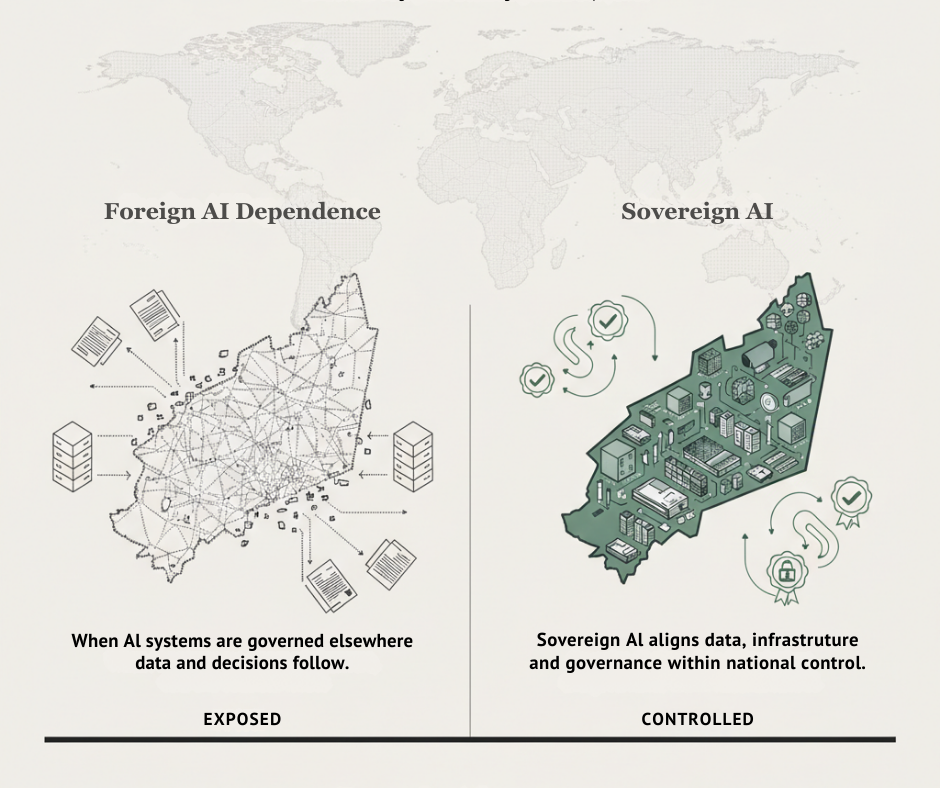
AI now determines economic power and national security. A handful of U.S. and Chinese tech giants control the global AI stack, creating systemic risk for nations and enterprises. Sovereign AI, the capacity to design, develop, and govern AI systems using domestic infrastructure, local data, and indigenous models, eliminates dependencies that expose nations to surveillance, coercion, or geopolitical leverage.
India risks losing its linguistic diversity in English-based AI models. Germany recognizes that strategic industries require computational independence immune to foreign policy shifts. Sovereign AI, the capacity to design, develop, and govern AI systems using domestic infrastructure, local data, and indigenous models, eliminates dependencies that expose nations to surveillance, coercion, or geopolitical leverage.
Geopolitical Autonomy and National Security
Dependence on foreign AI systems creates vulnerabilities identical to reliance on foreign energy or defense suppliers. When nations outsource AI to external platforms, they lose control over models, data processing, and infrastructure governing critical decisions from healthcare to defense logistics to financial stability. Foreign systems can contain hidden vulnerabilities that adversaries exploit, or provide foreign governments access to sensitive data revealing strategic intentions.
Recent events have made these dangers concrete. U.S.-China tensions disrupted semiconductor supply chains, while the EU AI Act holds AI providers legally accountable for bias and breaches, obligations foreign providers often refuse, leaving users legally exposed.
Sovereign AI returns control to domestic hands. India’s AIRAWAT supercomputer, ranked 75th globally, proves mid-sized economies can build world-class infrastructure. Plans to scale AIRAWAT to 1,000 petaflops would establish India as a regional AI hub. Sovereignty in AI now matters as much as sovereignty in energy, defense, and telecommunications.
Regulatory Compliance and Competitive Advantage
The EU AI Act, enforcing high-risk compliance requirements from August 2026, imposes stringent obligations: risk management systems, dataset quality controls, activity logging, human oversight, and robustness guarantees. Non-compliance penalties reach 6 percent of global revenue or €30 million, with board-level accountability now mandatory.
Organizations using foreign platforms face a visibility problem, they cannot verify training data, model weights, or inference logic. The foreign provider may claim liability, but the deploying organization shoulders reputational damage and regulatory scrutiny when failures occur. Sovereign AI eliminates this exposure by controlling every layer from data collection through monitoring, providing compliance certainty and legal control.
This advantage is driving major commitments. France pledged €109 billion to sovereign AI infrastructure through 2030, positioning Mistral AI as Europe’s regulatory champion. Mistral’s €1.7 billion funding round, backed by semiconductor firm ASML, signals European enterprises view sovereign infrastructure as essential. Mistral Compute’s 18,000 NVIDIA GPUs guarantee EU data residency and GDPR compliance without exposure to U.S. legal frameworks.
India’s BharatGen, funded with ₹988.6 crore in September 2025, addresses linguistic sovereignty, most frontier models marginalize India’s 22 official languages. By June 2026, BharatGen will support all 22 languages, enabling applications like Krishi Sathi (agricultural advisory) and Docbodh (bureaucratic simplification) that unlock value where English-based systems fail economically.
Sovereign AI in Use
The true test of sovereign AI lies not in infrastructure announcements, but in applications that solve problems global platforms cannot economically or operationally address.
Agricultural Innovation and Inclusive Development
India’s Krishi Sathi demonstrates sovereign AI’s value in markets global platforms ignore. This WhatsApp-based agricultural bot delivers crop-specific advice in Tamil, Marathi, Kannada, and Telugu, languages representing millions of farmers but insufficient revenue for Silicon Valley’s economics. The system is trained on Indian agricultural datasets, regional crop calendars, and local climate patterns too specialized for frontier models to justify acquiring.
Farmers receive timely pest warnings, irrigation guidance, and fertilizer recommendations in their native language, reducing crop failure risk and improving yields while enabling digital participation for populations excluded by English-only systems.
Government Modernization and Digital Inclusion
Citizens struggle to understand property deeds, tax forms, GST invoices, and court orders written in impenetrable legal language. Digitization moved forms online but preserved complexity, forcing reliance on costly intermediaries. Global AI platforms lack incentive to solve this, public sector budgets are constrained, procurement is slow, and each jurisdiction requires customization.
India’s Docbodh simplifies administrative documents into plain language, eliminating intermediaries and democratizing access. The UK’s AI Opportunities Action Plan, backed by £500 million, explicitly targets similar applications. Once built, sovereign systems replicate across departments, regions, and services at marginal cost, transforming citizen experience without perpetual vendor dependency.
Defense, Intelligence, and Critical Infrastructure
Certain AI applications permit no foreign dependency. Defense ministries cannot outsource logistics optimization, cyber defense, or intelligence analysis to platforms governed by foreign jurisdictions and commercial incentives.
Three requirements are non-negotiable: total control over infrastructure and models with no shared cloud environments, isolation from foreign supply chains that create leverage points, and alignment with national security doctrine rather than profit maximization.
Mid-sized economies like Germany, France, and India are now building defense-grade AI autonomously. This capability shifts geopolitical calculus, nations with sovereign AI infrastructure possess deterrence and operational independence that dependency eliminates.
These use cases reveal a pattern: sovereign AI succeeds where local context, regulatory requirements, and public interest outweigh the scale economics driving global platforms. What appears economically marginal to Silicon Valley becomes strategically essential domestically.
Conclusion
Sovereign AI represents a restructuring of geopolitical and economic power. Regulatory penalties, security vulnerabilities, and supply chain fragmentation have made the dependency model increasingly risky. Sovereign systems may not match frontier models on benchmarks, but they offer what matters more in regulated environments: jurisdictional control, compliance certainty, and immunity to foreign policy disruptions.
Sovereignty is not isolationism, leaders should deploy sovereign AI for mission-critical applications while using global platforms for exploration.